
It’s not just what you do…

Imagine an anniversary, in which a husband walks through the door with flowers, candy, and a card and tosses them casually on the couch where his wife is sitting and says, “Happy anniversary,” in a monotone. He does sort of air-kiss in her direction, though he keeps his eyes on the TV. He’s technically hit all the marks, but it’s not likely that his wife will be happy; because it’s not just what you do, it’s also how you do it.

Imagine a congressional hearing. The person called in for questioning shows up in a clown suit with Groucho Marx glasses (complete with big nose, mustache, and bushy eyebrows). He answers questions with a high squeaky voice and an affected lisp, just for fun. Though the witness shall have shown up as required and answered questions as required, there would be a number of very unhappy congressmen and women who would rightfully feel that their hearing had been taken lightly and mocked.  Because its not just what you do, it’s also how you do it.

It’s this way in the spiritual world as well. We must not only obey the technical command, we must also do it in the right way. For example…

  • It’s not just what we say, it’s the way we say it. Everyone understands that words are only part of communication — and not even the majority of it! Facial expression, vocal tone and inflection, body language, and more are all part of the equation, when we speak to each other. We must, for instance, do more than simply tell the Gospel; we must speak the truth in love (Eph. 4:15), with urgency (1 Tim. 4:2), in a kind way (Eph. 4:32), with gentleness (Php. 4:5), with persuasiveness (2 Cor. 5:11), with grace (Eph. 4:29), and with all seriousness (Acts 26:25). When we find ourselves in disagreement with others, we must speak respectfully (1 Tim. 5:1,2), kindly (Eph. 4:32), and wholesomely (Eph. 4:29) — without sneer, glower, condescension, or insolence (Rom. 1:30; 2 Cor. 12:20; 2 Tim. 3:2).
  • It’s not just that we serve the Lord, it is also the way we serve. Attitudes count with the Lord, the same way they count to us parents; and there’s a zillion of them — many of them not so great. Service to the Lord and to others (in many cases, they are one and the same thing) can be done with resentment or joy, with bitterness or enthusiasm, silly or seriously, with apathy or passion, and with selfishness or selflessness (see Php. 2:5ff). And it matters; God cares (see, for example, the Beatitudes of Matthew 5:3-12), and others care.
  • It is not just the sins we abstain from, it also the way we abstain. We can restrain our hands from doing something evil, while we drool over the sinful pleasure we’re missing at the same time. We can say no to a temptation, while our eyes and hearts are saying yes. Matthew 5:21ff gives numerous examples of how the deeds may look right, but the heart may be dead-wrong — not murdering, but hating; not committing adultery, but lusting; not lying, but not exactly telling the truth either.
  • It’s not just that we worshipped God in the five acts of worship in church, it also the way that we offer that worship. Jesus, in John 4, spoke about appropriate worship having the qualities of both spirit and truth — not just one or the other. Paul (1 Cor. 11-14) gives us several ways in which it should be done: In appropriate solemnity and focus (as in the teaching on the Lord’s Supper), with the brothers leading (14:34), decently and in order (14:40), with both the spirit and the mind (14:15), and with appropriate restraint (14:32,33).

Too often we get wrapped up in physical compliance to the physical deeds we are commanded to do, thinking that the spirit, the attitudes, or the manner in which we do things doesn’t really matter all that much. But they do! It’s a carnal vs. spiritual issue. It’s about avoiding the washing of cups only on the outside and whitewashing tombs — pretty on the outside, but unlovely on the inside (see Matt. 23:25-28). The inside does matter. It’s not just about what we do, it’s also about the way we do it.

Posted in Bible commentary, Christian Leadership, Christianity, New Testament | Tagged , , , , , , , , , , , | 1 Comment

The Fundamentals of Church Growth

The church of the first century exploded with growth — numerical and spiritual. Should we not be interested in a growing church, too? Not just for the sake of a larger bunch of people meeting on Sunday (like the membership drive of a social club), but for the sake of the souls that are lost without the truth of the Gospel. But how is it done? By a bus ministry or small groups or user friendly services? While these may be helpful, it is important to understand that they really are “gravy” and not “meat”. There are other things, fundamental things, that undergird biblical growth — things we need to be reminded of and do.

Love for each other

Never underestimate the power of love and fellowship.

Never underestimate the power of love and fellowship.

In John 13:35 Jesus tells us that the world will know that we are His disciples, if we have love for one another. No matter how compelling a presentation of the Gospel, outsiders will reject it, if love isn’t present. Indeed, weaker members of the Lord’s church will fail to stay, if love is a problem. Neither outsiders or weak members may know Christian doctrine really well, but they know that love is supposed to be part of following Jesus. Being friendly, kind, gentle, forgiving, and polite (yes, polite). It includes solving difficulties the Lord’s way (Matt. 5:23,24 and Matt. 18:15ff). And includes deeds of love and concern (see Romans 12 and 1 Cor. 13). If you haven’t shown love, not only is your soul in danger (1 John 4:20,21), but you stand in the way of the growth of the Kingdom.

Faith in what God can do

Mustard seed — Jesus used this very small seed to illustrate how an amazing outcome can come from only a small amount of faith

Mustard seed — Jesus used this very small seed to illustrate how an amazing outcome can come from only a small amount of faith


A regular fault of God’s people down through the ages has been faith — lack of it. Consider Moses at the burning bush (Exo. 2), David and the census (2 Sam 24), and Israel after the 10 faithless spies came back with a bad report (Num. 13). Think of the amazing things that happened, when men did act in faith — crossed the Red Sea, conquered Canaan, killed giants, were rescued from fiery furnaces, and walked on water! The world will probably never know all the amazing things that never happened, because God’s people lacked faith and refused to “step out of the boat”. When our God becomes “too small”, here is what happens: it displeases the God for whom nothing is impossible, it is a denial before the world (the world sometimes has more faith!), it keeps God’s blessings away, and hamstrings the progress of the church by limiting it to what we can do.

A clear understanding of the message
Because the denominational world has such a fuzzy, and politically correct picture of the Gospel, Christians themselves can sometimes get confused. And this is crucial because the Gospel (God’s Gospel) is the power of God unto salvation (Romans 1:16)!
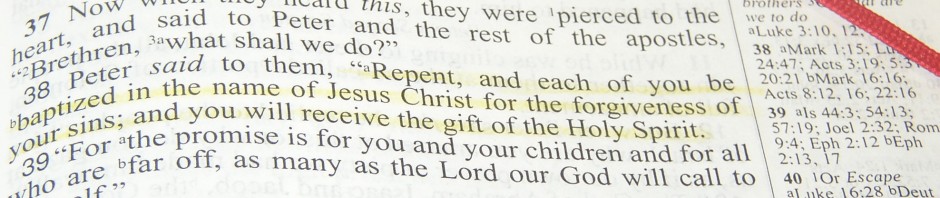
The Gospel isn't found in men's catechisms, books of discipline, missals, and theologies. It's found in the Scripture.

The Gospel isn’t found in men’s catechisms, books of discipline, missals, and theologies. It’s found in the Scripture.

The biblical Gospel is different from modern denominational messages. Its Jesus is different, its proper response to the Gospel is different, its definition of faith is different, its point of salvation is different, its definition of the saved is different, its understanding of the church is different, and its message about the state of the world is different. And a “different” gospel will fail to save. Men and women fail to be saved and the Kingdom is crippled, all from having a muddled or compromised idea of the message.

A clear understanding of the urgency of our mission
Too many of us are unclear on the importance of Lord’s commission. We “get” the Great Commission — making other disciples, baptizing them, and teaching them again (Matt. 28:18-20). And we “get” that we are to be following Him in word, thought, and deed — a light to the world, set on a hill. The part that we sometimes don’t get is its urgency and importance. It’s not an optional suggestion for the truly religious. People’s souls are on the line. It’s a high calling, and it should be a high priority — a transcendent purpose. Without it, leisure, games, hobbies and other lesser pursuits start to trump a soul going to Heaven.

Zeal and enthusiasm to make the dust fly
Jesus, Revelation 3:19, called the lukewarm Laodicean church to repent and be zealous again; because it is zeal, ignited in hearts touched by the cross, that moves us beyond the mundane, beyond obstacles, and beyond discouragement to the bold “moving of mountains”. Great men of the Bible were moved with faith and zeal: Moses, Joshua, David, Nehemiah, Isaiah, Paul, and (of course) Jesus. Without it the Kingdom stands tepid and cooling.

So, here are the fundamentals of a growing church: love, faith, urgency, message, and zeal. Imagine a church full of such disciples! The numerical and spiritual growth of the church (personally and corporately) would explode!

Are they there in your life?

Posted in Bible commentary, Christian Leadership, Christianity, New Testament | Tagged , , , , , , , , , , , , , , , , , , , , , | Leave a comment

What is Generosity?

I love generous people! Don’t you? And my congregation has many such people, who share their homes, their time, their talents, and their money.

And God loves generous people, too, because generosity is a part of holiness. Our God is Himself a generous God, and we are commanded to “be holy because I (God) am holy” (1 Peter 1:16); thus, Christians need to be or become generous. Like all of us, God appreciates a warm, open-handed generosity in the heart of His children — doesn’t it warm your heart, when your kids are honestly generous toward you or others?

In fact, Paul taught the church in Philippi about how God viewed their generosity:

“Not that I seek the gift itself, but I seek for the profit which increases to your account. But I have received everything in full and have an abundance; I am amply supplied, having received from Epaphroditus what you have sent, a fragrant aroma, an acceptable sacrifice, well-pleasing to God. And my God will supply all your needs according to His riches in glory in Christ Jesus.” (Philippians 4:17-19)

Note how their generosity increased “profit” to their account. Jesus spoke of such things as storing up “…for yourselves treasures in heaven, where neither moth nor rust destroys, and where thieves do not break in or steal” (Matthew 6:20). And Paul noted how the generosity of the Philippian church was being taken as a “fragrant aroma, an acceptable sacrifice” to God — and this, even though their generosity was being shown directly to Paul. Clearly, Jesus wasn’t exaggerating, when He said, “…Truly I say to you, to the extent that you did it to one of these brothers of Mine, even the least of them, you did it to Me” (Matthew 25:40). Generosity to others really is generosity to the Lord Himself.

But did you know that there’s even a promise connected with generosity? Listen to what Jesus said:

“Give, and it will be given to you. They will pour into your lap a good measure–pressed down, shaken together, and running over. For by your standard of measure it will be measured to you in return.” (Luke 6:38)

Paul echoes this promise in 2 Corinthians 9:8-11:

“And God is able to make all grace abound to you, so that always having all sufficiency in everything, you may have an abundance for every good deed; as it is written, ‘HE SCATTERED ABROAD, HE GAVE TO THE POOR, HIS RIGHTEOUSNESS ENDURES FOREVER.’ Now He who supplies seed to the sower and bread for food will supply and multiply your seed for sowing and increase the harvest of your righteousness; you will be enriched in everything for all liberality, which through us is producing thanksgiving to God.”

The principle seems to be that grace is met with even more grace, and generosity is met with even greater generosity.

But some may wonder, “What if I’m generous and God fails me?” Although there are several things that could be said to this question, the crucial question really is, “Was your gift a gift — or an investment?” A “gift” given with profit in mind is not really a gift, is it? That’s sort of the idea behind Jesus’ command,

“And He also went on to say to the one who had invited Him, ‘When you give a luncheon or a dinner, do not invite your friends or your brothers or your relatives or rich neighbors, otherwise they may also invite you in return and that will be your repayment. But when you give a reception, invite the poor, the crippled, the lame, the blind, and you will be blessed, since they do not have the means to repay you; for you will be repaid at the resurrection of the righteous.’” (Luke 14:12-14)

“Giving” to the Lord should never be part of a money-making scheme, like the televangelists preach — such things become investments not gifts, markers rather than grace. Someone has well said, “No gift ever made any man the poorer” — but, of course, we all know that investments often do — and in more ways than one! Generosity should be a real gift.

1 Chronicles 29:1-18 tells a wonderful story of real and generous giving. It lists the lavishly generous gifts of David and the other leaders of his kingdom given to build the temple of God, making special note of both the willingness and generosity of people who loved and wanted to honor the Lord. In verse 18 David says, “O LORD, the God of Abraham, Isaac and Israel, our fathers, preserve this (generosity) forever in the intentions of the heart of Your people, and direct their heart to You.” I would point out that “Your people” were indeed the Israelites at the time that David originally said this; but that definition has (through Jesus) now been widened to include you and me.

May, then, this continue to be true in us — that generosity be forever and always preserved in the intentions of our hearts.

Posted in Bible commentary, Christian Leadership, Christianity, New Testament, Old Testament | Tagged , , , , , , , , , , , | 2 Comments

Abraham’s Sacrifice of Isaac

Genesis 22 tells the riveting story of Abraham’s offering of Isaac. Isaac was the long awaited son of Abraham and Sarah. He had been promised when Abraham (“father of a multitude” — in honor of the promise) was still called Abram (“exalted father” — a name which must have sounded like mocking to him, each time it was said) living in Ur of the Chaldeas. Between the time of the original promise (Genesis 12) and the fulfillment (Genesis 21) 25 years of waiting in old age had passed. Both Abraham and Sarah had been in their mid-70’s at the time of the promise, which means that their faith in this promise from God had truly been hoping against any rational hope. Yet God had granted them a son, and they had named him Isaac (“laughter”).

But now — incomprehensibly! — God was directing him to offer his son in sacrifice, this son of promise that he had awaited so long, in a place called Moriah. And despite the terrible confusion that Abraham must have felt about such a command, he packs up and goes on this terrifying journey to Moriah with two servants and his son Isaac.

Just short of the mountain that God had designated as the place for the sacrifice, Abraham stops, puts the wood on Isaac’s back (what was often done to sacrificial animals), and tells their servants to stay behind — you might imagine why — but interestingly informs them, “we will worship and return”. “We”? It’s not that Abraham knew that God would send an angel to restrain his hand from killing Isaac. It’s not that he was just going through the motions and had no intention of following through — vv. 9,10 says he both “bound his son Isaac and laid him on the alter” and “stretched out his hand and took the knife to slay his son”; his intention is clear. So, what did he mean, when he said, “we will worship and return”?

Hebrews 11:17-19 gives us insight:

“By faith Abraham, when he was tested, offered up Isaac, and he who had received the promises was offering up his only begotten son; it was he to whom it was said, ‘IN ISAAC YOUR DESCENDANTS SHALL BE CALLED.’ He considered that God is able to raise people even from the dead, from which he also received him back as a type.”

Abraham was so full of faith in God that he was apparently thinking that if he obeyed God and sacrificed Isaac, God would simply raise him up again. Now, that’s faith! No wonder that Abraham is called the “father of the faithful”.

And you know, it’s not really too hard to spot real faith. It’s obedient. It lives like it can see the unseen realities God reveals to us in His word. It doesn’t hesitate or approach obedience uneasily. It acts with certainty and confidence despite threats or fears.

And it’s a good question for every Christian to ponder, “Does my life reflect my faith or my fear? Does my life — my acts/deeds/attitudes — reveal that I believe more in what my eyes see and ears hear, than I believe in God?”

Let’s live our lives, so that our faith in God shines clearly for all to see. Let the world scorn us, laugh at us, call us old-fashioned, or even fools. According to Psa. 14:1, it is the fools who say — or live like — there is no God.

Posted in Bible commentary, Christian Leadership, Christianity, New Testament, Old Testament | Tagged , , , , , , , , , , , , , , , | Leave a comment

How to Give the Right Way

Note: This posting comes from an article that I wrote for the Manchester church of Christ on January 9. I thought that perhaps those who are in ministry or others who are disciples generally might be interested in thoughts about this under-taught topic.

Giving is a touchy subject. It shouldn’t be, but it is. Perhaps because it is a touchy subject, it doesn’t get taught much — except by televangelists who usually are just after money. And that’s too bad, because giving is a spiritual exercise that is sometimes hard to do right — with the right attitude, at the right time, with the right amount, with the right aim, and with the right heart. Like any other spiritual endeavor, giving has a pattern, and doing it right needs some biblical guidance. May I point a few things out…

  • The right time — There are two authorized times to give found in the New Testament. The first is whenever you see a need that you can individually help with (Gal. 6:10). This sort of giving is easy to engage in, we see the results quickly, and multiplied by all of us, it makes an impact. The second is every first day of the week (1 Cor. 16:1ff), when we have the opportunity to give as a congregation to things we have decided (with the Lord’s guidance) are important works for our church to be engaged in. Congregational giving allows us to do more than any of us can do individually, but is the sort of giving that we seem to like least — perhaps because we don’t consider the many individual things we are participating in as we give this way. Do you give at all the right times?
  • The right heart — There are several wrong attitudes with which we can give: grudgingly, covetously, and reluctantly to name just a few. But the heart of right giving is primarily gladness, joy, and thanksgiving. Some might find it almost inconceivable that the Macedonians begged Paul for the privilege of giving beyond their ability (2 Cor. 8:1-5). But this is exactly what joyful, grateful hearts do. A joyful attitude in giving begins with a love a God who has shown us all so much mercy and blessing; and it continues with a love for others, an unselfish desire to help, and a trust in God to provide. The wrong heart of grudging reluctance in giving comes from materialism that always fears that there will not be enough for self. If you’ve never given with gladness, thankfulness, and joy, you don’t know the spiritual growth and happiness that you are robbing yourself of. Do you give with the right heart?
  • The right amount — A tithe was the Old Testament standard, but there are two standards for right giving in the New Testament standard — generosity (2 Cor. 8) and “as you have been prospered” (1 Cor. 16:2). Generosity is better and usually exceeds a set percentage, because it doesn’t want to give “until it hurts” but rather “until it feels good” — until it has become a real gift. And “as you have been prospered” recognizes that generosity is measured on a sliding scale: some have more that they can share than others. The New Testament standard seeks a “gift” not a “tax”. Are you giving a generous amount for you?
  • The right aim — The aim of giving is never to simply “to give”, even though the mere act of giving actually does us personal good. Nor is the point of giving just to do one’s duty, even though it is a command from God. Unfocused giving is irresponsible stewardship. The main aim of giving is to help the Kingdom, to help the needy, and to glorify God. Paul told Titus, (Titus 3:14) “Our people must also learn to engage in good deeds to meet pressing needs, so that they will not be unfruitful.” This is why the church leadership works hard at budgeting and crafting a set of ministries that they believe will benefit the church and the lost world. But even in our personal giving, we must aim carefully to meet pressing needs. Is your giving properly aimed?

We don’t speak of giving often, because it sounds like all we’re interested in is money. But this is the time of the year, when our leadership looks at the expenses of continuing the good things that this church does and seeks to work within a budget. And it’s also a good time of year for everyone to remember all the good things that our congregation does and how much you’d like to contribute toward those good things. Let me urge you to give right in 2013, like the first century Macedonians did.

2 Corinthians 8:1-5 “Now, brethren, we wish to make known to you the grace of God which has been given in the churches of Macedonia, that in a great ordeal of affliction their abundance of joy and their deep poverty overflowed in the wealth of their liberality. For I testify that according to their ability, and beyond their ability, they gave of their own accord, begging us with much urging for the favor of participation in the support of the saints, and this, not as we had expected, but they first gave themselves to the Lord and to us by the will of God.”

It’s all a part of being “A Light to be Seen in 2013”.

Posted in Bible commentary, Christian Leadership, Christianity, New Testament | Tagged , , , , , , , , , , , , , , , , , , , , , | Leave a comment

New Year’s Resolutions — “A Light to Be Seen in 2013”

Along with every new year comes an instinctive look back at: where we were, where we went, what we did, who we were, how we wish things had been different, and what we want to do differently in the future. And that’s where the annual resolution tradition comes from. Generally speaking, however, new year’s resolutions — whether weight loss or growth in godliness — have poor track records; the bad habits prove hard to break, the change is uncomfortable, and before too long the efforts to change just seem like too much trouble for the benefit.

But change is a key component of Christianity. We’ve not been saved to live the same old life, but to live a new life in Jesus. So, how do we make our well-intentioned resolutions into well-executed transformations?

Put some revolution into your resolution — Because we are often disappointed in our own ability to keep resolutions, many of us have set our goals pretty low. Convinced that mediocrity is the best we can accomplish, we settle for “better than most folks”. Hogwash! God has much higher goals for us than “better than most folks”! Don’t be afraid to put a little revolution into your resolutions. That’s the whole idea of transformation (Romans 12:1,2)! That’s the whole idea behind being a light in the world (Matt. 5:14,15). And it’s the whole idea behind your resurrection at your baptism — a new kind of life (Romans 6:1-7). Don’t believe the accusations of Satan (the Accuser) that you could never become what God wants you to be! We just need to step out onto the water, in a manner of speaking, and depend on Him for the power to walk on it. And even if we miss, look at how much closer we are than when we began.

Find a set of motivations — One motivation will likely not be enough. Circumstances are so varied and our human hearts are so good at justification that in order to “hold the line” on our resolutions, it will be important to have multiple strong motivations. List them for yourself, prioritize them from the most powerful to the least, and place them before your eyes daily. If one fails, the next may give us the strength we need.

Put some resolve into your resolution — And don’t be afraid to list negative motivations like consequences, the displeasure of God, or what my brothers in Christ might think. Negative motivations may not be the highest of inducements to do right, but they can be effective “back-stops”, when every other “high” motivation has yielded before temptation. We certainly need to grow beyond fear, to love and idealism, but the Christian mustn’t disdain fear of the Lord as a means to strengthen our determination to do right. Such motivations can give us a backbone, some resolve, when other motivations have melted away.

Determine what your life should look like this time next year — Ideals, patterns, and standards are used everywhere in Scripture, because they provide both motivation and a target to aim our spiritual, mental, and physical energies at. “Better” is just not specific enough; God’s ideals, patterns, and standards, on the other hand, give us specifics. Look into God’s word and find out what God’s ideal for you would be. “Better” can be any standard. It is true saying that if you aim at nothing, you hit it every time.

Determine what our congregation should look like this time next year — Patterns of the Lord’s church must never be changed, but there are things that we can always improve beginning with ourselves. Consider our love for one another, our zeal, the effectiveness of our Bible classes, the number of new Christians, the number of evangelistic studies, the number of members actively involved in the Lord’s work, the fervor and engagement of the congregation in our times of worship. Having an ideal in mind and doing our part to make it a reality is an effective path for a whole congregation’s spiritual improvement.

The story is told of a man and his son who were late for a train. As they reached the station and were buying tickets, they heard the public address system announce that the train was leaving the station — “All aboard!” The father and his son ran for the platform only to see the train starting to move out and slowly accelerate out of the station. The son began to melt, but the father ran all the faster dragging his son along with him.

“We’ll never make it. We’ll miss the train!” the boy protested.

“Maybe so,” replied the father, “but we’ll miss trying.”

The biblical standards are high and holy, because our God is high and holy; but that doesn’t mean that we should “dumb down” our attempts at pressing on toward the goal. We may miss the mark of perfection, but let’s miss trying!

Posted in Bible commentary, Christian Leadership, Christianity, New Testament | Tagged , , , , , , , , , , , , , , , | Leave a comment

The Humble Still Receive Him

Though over 2000 years have come and gone since the coming of Christ, some things have changed very little — “Wise Men Still Seek Him”, “Evil Men Still Are Troubled by Him”, “The World Still Doesn’t Recognize Him”, and “The Angels Still Praise Him.” For the last thought of this series I want to ponder the humble shepherds in the fields, who first heard the glorious news, and who chose to go into Bethlehem to see the thing that the Lord made known to them — the birth of the Savior of the world.

Why did the Lord choose shepherds to first tell the good news to? Shepherds aren’t anyone important by the world’s standards; they aren’t influential leaders of the community; they’re “blue collar” rural workers who often spend considerable amounts of time alone in wilderness areas. I would suggest that it was for the very reason that they were not important or influential — rather they were humble. But it was not just because God favors the poor or underprivileged.

Humility, you see, is not about being a poor, under-educated peasant; it is not an economic or educational condition. Humility is an attitude of heart. True, it can be “cultivated” by not having the wealth, education, skills, etc. that often fool us into thinking that we’re more than we really are — that we know what we’re doing, that we’ve got it all under control. The poor and under-privileged are often a bit more realistic about themselves; less prone to painting a pretty (but self-deceived) picture of themselves; more aware of what they don’t know and can’t control; and less likely to brush off faith, God, and religion as unnecessary — more humble. And it is the humble that God regularly seeks out first.

In the famous Sermon on the Mount, as Jesus gives us the Beatitudes — a sort of “Discipleship 101” — He begins significantly:

“Blessed are the poor in spirit, for theirs is the kingdom of heaven. Blessed are those who mourn, for they shall be comforted. Blessed are the gentle, for they shall inherit the earth. Blessed are those who hunger and thirst for righteousness, for they shall be satisfied.” (Matthew 5:3-6)

Please note: “poor in spirit”, “those who mourn”, “the gentle (humble)”, and “those who hunger and thirst for righteousness”. Such qualities don’t sound much like kings, Wall St. giants, or know-it-alls. But they are the qualities Jesus first requires of His hearers at the very start of this famous teaching. Why? Because the “poor in spirit”, “those who mourn”, “the gentle (humble)”, and “those who hunger and thirst for righteousness” will actually listen. They won’t try to argue Jesus down to “be reasonable”. They won’t minimize, explain away, or discount His teachings. They won’t rationalize or justify themselves as Jesus exposes their sins. They’ll listen, digest it, and obey.

It was a humbled Moses (not “Prince Moses”) who finally listened to God and led Israel out of Egypt. It was humble shepherd-boy David (not proud king Saul) who listened to the Lord and slew Goliath. It was a humbled Saul of Tarsus (no longer a proud Pharisee) that would become the apostle Paul. Humility is a self-evident, crucial, and yet little practiced key to following the Lord.

Imagine if the angels had come to a local group of Pharisees or chief priests, instead of the shepherds; or imagine if the incarnation had happened today and the angels had appeared to some scientists, or theologians, or politicians. There might have be conferences and reports and debates — some might suggest that the angelic appearances were really swamp gas or a super-secret military experiment. But there would probably have been very little or no, “Let us go straight to Bethlehem then, and see this thing that has happened which the Lord has made known to us.” That’s what happens without humility.

Want proof? The holy messengers of God still speak to us in the Bible, yet there are still many who seek to rationalize, justify, discount, explain away, argue away, and ignore what it says. It was drawn to my attention recently that there’s a new version of what is being called a Bible — the “Queen James Version” — which (as you might have guessed) has “re-translated”, cut out, or attempted to explain away all references to homosexuality as sin. And its authors are not alone; there are many who are not at all eager to just listen and obey.

Don’t get me wrong; don’t misunderstand. This is not to say that to be a disciple that we have to check our brains at the door — just our pride, our rationalizations, and our justifications. It is still just as true today as it was 2000 years ago, the humble still receive Him.

Posted in Bible commentary, Christian Leadership, Christianity, New Testament | Tagged , , , , , , , , , , , , , , , , , , , | Leave a comment

The Angels Still Praise Him

Over the last few weeks we’ve been taking a look at the stories surrounding the birth of Jesus, the Christ. In these little meditations I’m hopeful that you’ve noticed that the more things change about mankind, the more they remain the same: “Wise men still seek Him”, “Evil men are still troubled by Him”, and “The world still doesn’t recognize Him”. And one more thing that hasn’t changed, angels still praise Him.

Hills around Bethlehem

Hills around Bethlehem — where shepherds watched their flocks by night and heard the announcement of the birth of the Savior

In Luke’s telling of the birth of Christ (Luke 2:8-20), he documents a special, visible outburst of angelic praise witnessed by humble and startled shepherds in the fields near Bethlehem, when Jesus was born. And you can easily understand why, an extraordinary, unprecedented, wonder-filled event was taking place — the incarnation of the Creator into the world He had created for nothing less than the redemption of mankind! It was no mere man who was born; this Child was God coming from His eternal existence to become temporal flesh! The magnitude of this event rivals creation itself and the resurrection/judgment day. It is the beginning of a superlative intervention that would end, surprisingly, in a cross and an empty tomb, potentially changing the eternal destiny for billions! If it hadn’t been announced to at least these few poor shepherds in the fields, the angels surely would have burst from excitement and praise — and with them, the very creation itself (see Luke 19:40)!

“But the angel said to them, ‘Do not be afraid; for behold, I bring you good news of great joy which will be for all the people; for today in the city of David there has been born for you a Savior, who is Christ the Lord. This will be a sign for you: you will find a baby wrapped in cloths and lying in a manger.’ And suddenly there appeared with the angel a multitude of the heavenly host praising God and saying, ‘Glory to God in the highest, And on earth peace among men with whom He is pleased.’” (Luke 2:10-14)

This was way more than just a few thrilled heavenly visitors looking through the glass at the newborn Jesus’ nursery. It was the mind-blowing beginning of the come-back of God’s perfect creation, tragically marred by sin and death. It was God loving, becoming part of, and fully experiencing His creation to rescue it — rather than just wadding it up like a ruined draft to start over again, which is what we deserved. Amazing! Worthy of infinite thanks and praise!

And now He is ascended, having accomplished His mission: living among us, being tempted like us, teaching us, suffering like us, suffering FOR us, dying like us, dying FOR us, and redeeming us — all without sin. Now He receives the praise, glory, and adoration of victory and achievement from angels and saints:

“And they sing a new song, saying, ‘Worthy are You to take the book and to break its seals; for You were slain, and purchased for God with Your blood men from every tribe and tongue and people and nation. You have made them to be a kingdom and priests to our God; and they will reign upon the earth.’ Then I looked, and I heard the voice of many angels around the throne and the living creatures and the elders; and the number of them was myriads of myriads, and thousands of thousands, saying with a loud voice, ‘Worthy is the Lamb that was slain to receive power and riches and wisdom and might and honor and glory and blessing.’” (Revelation 5:9-12)

Now, He is Redeemer (Titus 2:14), Judge (2 Timothy 4:8), King (Revelation 17:14), High Priest (Hebrews 2:17), and elder Brother (Hebrews 2:11)! Not enough can be said about Him or in heart-felt praise of Him; because Who He is and what He has done is great beyond words or even comprehension.

Even so, it is sometimes difficult to encourage men today to come worship; and even more puzzling, those that do come, sometimes offer only half-hearted, perfunctory praise. Surely, the angels must watch such earthly happenings with mouths agape in disbelief!

Yes, on that night over 2000 years ago, when Jesus was born, it may have been just another baby by human eyes, but to the eyes of angels, and to the eyes of faith — those able to see past the humanly-visible to the more dramatic spiritual reality — there was enough to praise God in the highest!

Will you see Him this Sunday (and every Sunday — and every day) with the eyes of flesh or the eyes of angels and of faith?

Posted in Bible commentary, Christianity, New Testament | Tagged , , , , , , , , , , , , , , , , , , , , , , , , | 1 Comment

The World Still Doesn’t Recognize Him

Over the last couple of weeks we’ve been taking a look at the stories surrounding the birth of Jesus, the Savior. We’ve noted that a lot of fundamental things about humanity haven’t changed, since that time: “Wise men still seek Him”, “Evil men are still troubled by Him”, and (today) “The world still doesn’t recognize Him”.

One of the more famous parts of the story of Christ’s birth is when Joseph and Mary came to Bethlehem and found no room at the inn. I’ve noted in some of my articles from years past that we often fill our lives up with lesser things, so that there continues to be “no room left in the inn” of our hearts for Jesus. I still think that this is a valid point to ponder, but I think there’s more to this story. In a couple of ways you really can’t blame the innkeeper. Joseph, Mary, and the unborn Jesus arrived at the Bethlehem inn without reservations, and neither did they carry any credentials as the “holy family”. Mary and Joseph came looking poor, common, road-weary, and a little bit desperate. They didn’t look the way you would expect the parents of the Messiah of the world to look — no halos, no royal robes, no tiara, no soft hands, not even a secret service detail (at least, not one you could see). It is no wonder that the innkeeper found no room for such ordinary-looking people.

The Jews who were certainly looking with great anticipation for the Messiah in the first century, like the innkeeper, also had expectations that had nothing to do with God’s reality. One of the major reasons that Jesus was rejected in His day was that He didn’t look like the Messiah that they expected or (more to the point) wanted — a regal looking king, a steely-eyed military commander bent on restoring a united Israelite empire of David and Solomon, defeating all the enemies of the Jews, and ushering in an unprecedented age of peace. Jesus, on the other hand, came looking like a common, working-class fellow, who associated with fishermen, tax-gatherers, and other peasantry. He came gathering no armies, defeating no Romans, and He mostly just taught about the Kingdom and righteousness like a poor, itinerant rabbi. What the Jews of Jesus’ day should have been looking for (but didn’t) was “the times” (Matt. 16:3), the “forerunner” (Lk. 1:17), the miraculous signs (Matt. 11:5), the prophetic fulfillments (Matt. 1:22), the message, and the resurrection (Acts 2:27). Instead, looking for all the things He wasn’t, they overlooked the King of kings. You usually find only what you’re looking for.

Interestingly enough, people still don’t recognize Him. People may not have the exact same misconceptions of the Messiah as the first century Jews, but the misconceptions they do have still hide Him from their eyes — they see only what they’re looking for. For example, the world looks for a god and messiah of only undiluted love and grace. They seek a god and messiah who isn’t really interested in things like morality and holiness, who will accept and smile down upon anything offered in worship, for whom doctrine and unity are irrelevant, for whom diversity and inclusion are the greatest good, and who — although full of bluster and empty threats — wouldn’t hurt a fly. And since that’s the sort of “jesus” that they’re looking for, that’s the sort of “jesus” that they find. So, when the real Jesus comes to men of today in the Gospel as the real God and Messiah that He is — rightfully expecting obedience; full of love and grace, but also full of justice and judgment,; concerned with holiness, righteousness, doctrine, truth, unity, and worship as He has commanded; who originated the idea of “the chosen”; and who simply never issues an empty threat — such a Jesus is not recognized as the real God or Messiah. Modern men think, “He just couldn’t be.” So, they reject the real Jesus — the Jesus they need to save them — and seek for and worship a “jesus” of their desires who will do them no good.

It would seem that we human beings always want the messiah that we want, not the Messiah that He is — the One we need. We want a god that can be modified and customized to meet our tastes and desires, but the God of the Bible remains exactly who He always was, is, and will be — immutable. The Hebrew writer tells us, “Jesus Christ is the same yesterday and today and forever” (Hebrews 13:8).

Finding “room in the inn” only for a messiah that they wanted was cataclysmic for many of the Jews of the first century — they rebelled against Rome twice, and were crushed twice. Finding room in the inn of our hearts for the “jesus” we want will inevitably be even more cataclysmic for us than for the first century Jews — the consequence is eternal separation from God. Recognize and accept Him as the God, Lord, and Messiah that He is, and the outcome is life.

Do you have “room in the inn” for the real Jesus?

Posted in Bible commentary, Christianity, New Testament | Tagged , , , , , , , , , , , , , , , | Leave a comment

Christmas Thoughts — The Evil Are Still Troubled By Him — Herod

We’re looking at the stories usually associated with Christmas in these weeks approaching Christmas. Last time we studied the story of the magi in Matthew 2:1-18, and we concluded that wise men always seek Jesus. This week we’ll take a look at the other side of the coin in this story, Herod and the religious leaders of Jerusalem.

When the magi from the east came to Jerusalem, Israel’s capital, seeking the One born King of the Jews, it threw things into quite an uproar in both the palace and the Temple — “he [Herod] was troubled, and all Jerusalem with him.” Herod’s wife wasn’t pregnant, so this news meant only one thing to Herod, someone was being born who would take Herod’s throne from him and his family! Quickly Herod gathered the chief priests and scribes to ask what the Scriptures said about the birthplace of the “King of the Jews” — to answer the magi’s question, of course. King Herod then called the magi aside privately and after finding out the exact time of the appearance of the star that they followed, he told them, “Go search carefully for the Child; and when you have found Him, report to me, so that I too may come and worship Him.”

Herodium, Herod the Great's final resting place

Herodium, the tomb of Herod the Great.

After the magi found Jesus, however, they were warned by God to return a different way. When king Herod realized that his magi “spies” had not returned, he quickly composed plan B — kill all the male children two years old and younger. He was too late to kill the King of the Jews, however; God had warned Joseph of the danger in a dream and the whole family had escaped to Egypt. They were able to return to Israel/Judea after Herod the Great died.

What was so troubling to Herod that he took such extreme action? Every king realizes that there’s only one exit for himself or his family — death. And Herod was not a legitimate king — he was an outsider (Idumean by nationality, not Jewish) who had been appointed by the Romans. Herod knew that a legitimate King of the Jews was a significant  threat, and he was keen on eliminating threats. In many regards Herod is much like the sinful world today, still wanting to illegitimately sit on the throne of their lives, to never yield sovereignty of their lives over to the legitimate King, the Creator — and realizing that yielding the throne will mean death (e.g., Luke 17:33 “Whoever seeks to keep his life will lose it, and whoever loses his life will preserve it.” and Romans 6:1-6). Sinful men, who seek to cling the throne of their hearts, are still troubled by Jesus.

But it wasn’t just Herod who was troubled, the chief priests and religious leaders were, too. You’d expected the religious leaders to have saddled up and followed the magi to Bethlehem, wouldn’t you? They should have been the first to worship and submit to Jesus; yet they were also “troubled”. But a change in administration, in the status quo, would be unprofitable and humbling and possibly fatal to them, too. They needed to protect their interests first — “Who cares about God’s interests?” Those who should have cared, did not. In fact, it is this group (although there were different individuals involved) who called for Jesus’ death on the cross 31 years later! Even then, they failed — He rose again!

Neither the “Herods” nor the “chief priests” of this world will ever be successful in ridding the world of Jesus or His church. They hate Him; they are troubled by Him; and will deny Him, discredit Him, mock Him, marginalize Him, and still try to kill Him in attacks on His church — sometimes including actual martyrdom of God’s people — but all to no avail; because, among other things, they can’t outlive Him. Jesus authoritatively told us, (Matthew 16:18) “…upon this rock I will build My church; and the gates of Hades will not overpower it.” Later, in Revelation 12, we find a summary of the grand scope of spiritual history in colorful symbols, in which Satan (the dragon) tries again and again to kill and thwart the coming of the Messiah (the male child) and God’s people (the woman), but fails over and over through God’s power and providence — and is ultimately thrown (along with the beast and the false prophet) into Hell eternally (Rev. 20:10).

So — wise men still seek Him; sinful men still hate Him. Are you among those who seek Him or those who are troubled by Him?

Posted in Bible commentary, Christianity, New Testament | Tagged , , , , , , , , , , , , , , , , , , , , , , , , | 1 Comment