
We ended yesterday’s blog with an strong warning from Paul to the Roman church about the sin of division. Paul certainly had good reason to worry about division in the church at Rome, but his concern was probably heightened from his experiences in the Corinthian church — he was writing Romans from Corinth, you’ll recall.
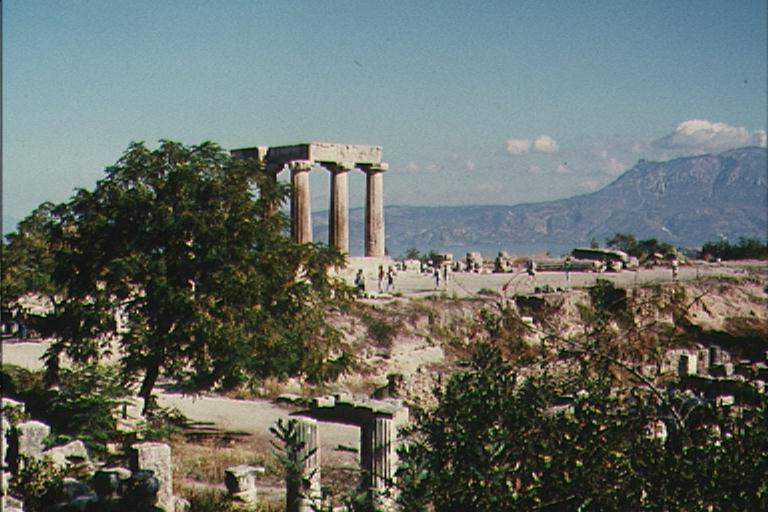
Temple of Aphrodite in Corinth
The church in Corinth was dear to Paul. He had spent more time in Corinth than anywhere else he had done mission work, with the exception of Ephesus; because the Lord had specifically told him that He had many people in Corinth (i.e., there were a number of folks who were open to the Gospel of Christ). As you read through both 1 and 2 Corinthians we discover that Paul wrote not two but a total of 4 letters to Corinth to attempt to straighten out their troubles — and they had some serious troubles that might have cause lesser evangelists to throw up their hands in frustration (“These immoral Gentiles are simply beyond redemption!”). But Paul kept working with them, opening his heart to them, though some in the church appear to have held Paul in contempt. A study of the Corinthian letters, therefore, is a great study in fixing problems in churches of all ages — a study of which I’ll only be able to touch the hem of the garment in this blog.
Corinth was located on a very narrow stretch of land, only about 4 miles wide, connecting northern Greece with southern Greece. This strategic location made Corinth an important seaport, since merchants could several eliminate days of travel, sailing around southern Greece to destination ports in either Italy or Asia. Like all busy seaports it was a nexus of cultures, nationalities, ideas, and religions.

A Corinthian sphinx. Sphinx was an Egyptian figure, this Corinthian sphinx shows how cosmopolitan Corinth was
This made it a perfect spot for Christianity to be planted and spread around the Mediterranean basin. But like all busy seaports it was also prosperous and had a reputation for moral corruption, and this provided Paul with plenty of challenges. The first one we’ll see today is division and the wisdom of men. Let’s dive in to the text…
Agree! — 1 Cor. 1:10
A careful reading of the letter to the Corinthians reveals that the church was divided in three ways: economically (the rich and the poor), ethnically (Jew and Greek), and affininity (Paul, Apollos, and Cephas/Peter). Paul’s command was that they unite and agree. I point this out for emphasis, because even today some would consider Christian unity an impossibility. Listen, God has never commanded or expected the impossible of His people, and when we are told that to be God’s we must unite, then we need to swallow whatever pride, whatever jealousy, whatever enmity, whatever opinions, whatever tastes, and whatever preferences we might have and UNITE under God’s directions and patterns.
Foolishness of the message preached — 1 Cor. 1:21
This statement comes in the midst of a larger point that Paul makes about worldly wisdom and godly wisdom, and it makes a great contribution to argument that worldly wisdom will get you nowhere. But I wanted to emphasize this thought for a moment to encourage sharing of the Good News. While it is true that the world may indeed hold the Gospel in contempt, thinking it old-fashioned or too restrictive or even foolish; it really is the only hope of eternal life. Remember, Paul said, Romans 1:16, “For I am not ashamed of the gospel, for it is the power of God for salvation to everyone who believes, to the Jew first and also to the Greek.” So, let the world mock and scorn us for telling people what the really need to know, and preach anyway. And don’t think that your contribution to the sharing of the Gospel might be too insignificant; in the slightly larger context of this verse Paul reminds us that God has chosen the foolish things, the weak things, the base things, and the despised things to do His best work (vv.26-29). If you think what you can contribute to the spread of the Gospel is insignificant, you may be the very person that the Lord is looking to use in great ways. Think about that!
A natural man does not accept the things of the Spirit of God — 1 Cor. 2:14
The world operates off of what it can see, hear, observe, touch, etc. It sees no farther than this world. The spiritual man, on the other hand, sees beyond this world — not that he’s especially talented, but that God has revealed what is beyond the seen. It is no wonder that they world thought that preaching Jesus on the cross was foolish, because ALL they saw was a dead man on a piece of wood. When the rulers of this world (those that condemned Jesus) looked at Jesus, all they saw was a carpenter, who bled like every other man and who should be eliminated because He was “stirring up trouble”. What they failed to see was what was beyond their physical sight. This is a call for us all to see the unseen. Later, in 2 Corinthians, Paul tells us how he was able to continue on in ministry as beaten and persecuted as he was, 2 Corinthians 4:18 “while we look not at the things which are seen, but at the things which are not seen; for the things which are seen are temporal, but the things which are not seen are eternal.” If you’re sharing the Gospel with others, here’s the real challenge, isn’t it: getting them to see the spiritual realities as reveal by the only true and living God.
The first denominations — 1 Cor. 3:3-9
Denominationalism is considered to be an acceptable state of affairs in Christendom. Indeed, in a world that values inclusion more than what is right, it is considered the only way that Christendom can have any sort of union. But here in chapter 3 we see the first denominations emerging — and the inspiredapostle Paul isn’t happy. This should tell us something about what we’ve accepted as the norm and as necessary: it is neither necessary nor should it be the norm.

A Corinthian mold, pattern. Romans 6:17 “But thanks be to God that though you were slaves of sin, you became obedient from the heart to that form of teaching to which you were committed,”
This was the starting place of the Restoration Plea in America — and not just America. This clear truth about the unity of the church has occurred around the world — any place that has Bibles to read and denominations to confuse things. Return to the Bible; follow God’s patterns; be Christians only.
Destroy the Temple of God? — 1 Cor. 3:16,17
Paul, in an attempt to underscore how serious the sin of division was (apparently the Corinthians didn’t see it as a big problem), compares division of the church to an attempt to destroy the Temple of God — which is what the church is. Now, Paul is later going to tell us that division is sometimes necessary, when people are teaching false doctrine, but it is like amputation to save the whole body from death. The church in Corinth was dividing over opinions, economic divides, social lines, ethnic boundaries, and other foolishness (worldly wisdom). But lest we begin clucking our tongues in scorn, let’s take a look at the modern things that people still want to divide over. It still amounts to destruction of the Temple of God. This is no minor matter. This is a big deal. Would you really want to face judgment on the last day as the destroyer of the Temple of God?
See you tomorrow, Lord willing



 parklinscomb
Patterns of Christianity — 1 Corinthians 1-3
In today’s reading Paul continues to try to work with the divisions of the church in Corinth. He’ll continue dealing with the “denominational” division of the groups who wanted to follow Paul, Apollos, and Peter. He also addresses two moral issues that threatened to split the church — sexual sin and law suits! The principles that he uses to straighten things out are important for church leaders to still know and practice.
Learn not to exceed what is written — 1 Cor. 4:6
One of the doctrinal things that some of the Corinthians appear to have gotten wrong, is the timing of our glorification. Somehow, they had gotten the impression that they were already in a glorified state — perhaps because of the miracles that some of them were performing (speaking in tongues, healing the sick, prophesying, etc.). It had puffed up their pride and caused them to scorn the apostle Paul, who had brought them the Gospel, and look down on their other Christian brothers and sisters. Paul sets out to correct this here and later, too; but here he reminds them to not exceed what is written in Scripture.
This principle applies in many, many other situations in matters of Christian faith. One of the biggest problems among those who claim Christianity is exceeding, going beyond, what is written in Scripture. Like these first century brothers in error, men still sometimes think that they’re wise enough OK things that God has not OK’ed and forbid things that God has not forbidden (see Matthew 18:18). This principle is part of the idea of following the pattern (Romans 6:17) — you don’t cut too much off and you don’t add anything more to it. Christianity really can be just fine, perfectly inspiring and fulfilling exactly as is in the Bible; it can give us the salvation that we need, the hope that we long for, and the way to live that we must have — no human tinkering needed.
Just as I teach everywhere in every church — 1 Cor. 4:17
Here is more evidence of that pattern that Paul was hoping they were adhere to. Contrary to what some would say, Paul’s letters weren’t intended to be uniquely occasional. He certainly applied commands and principles to circumstances that the various churches faced, but they were standard commands and principles that he taught everywhere in every church. They applied to Rome, Corinth, and Ephesus in the 1st century as well as to New York City, Los Angeles, and Mexico City in the 21st century.
Withdrawal of fellowship — 1 Cor. 5
It certainly isn’t something that any sincere disciple would hope to happen, but sometimes circumstances do arise in which someone in the church needs to be withdrawn from. When someone in the church is sinning publicly and unrepentantly the Lord demands that fellowship be withdrawn from him. Legitimate reasons include matters of morality (as in this case in 1 Cor. 5), division (Romans 16:17ff), doctrine (Galatians 1:8,9), and leading an unruly life (2 Thess. 3:6). It should be done for two important reasons: 1) the offender needs to understand the seriousness of what he has done (that it has put him out of fellowship with God and His church) and 2) the church itself needs to be protected from a sinful example and implied consent from the leadership regarding such behavior. It is always a tremendously difficult — even heart-rending — thing for the leadership and the church to do, if the fellowship and love are what they are supposed to be. But Christianity calls upon us to do the difficult things.
Lawsuits? — 1 Cor. 6:1-11
The Roman world was almost as law-suit happy as we are. The problem in the Corinthian church was that some were even bring their brethren to court. Such a state of affairs was shameful and brought reproach on the church from the world. Paul rebukes bringing a brother to secular court, and offers a couple of interesting but very seldom used solutions for problems among Christians. One was put together a Christian court and let their decision be final. A second solution was to just choose to be wronged and forget all about your law suits, knowing that God would make things right in the end.
Sexual immorality — 1 Cor. 6:12ff
Sexual morality was a serious problem in the first century world. The philosophers had taught and encouraged every other virtue, but the only generally recognized sexual sin was adultery — for women. Consequently, soliciting prostitutes and engaging in homosexuality were widely practiced by even married men. Enough so that reining in such sexual desires constituted a real challenge and the reason why Paul needed to deal very sternly with the brother in chapter 5 and the rest of the congregation. Such sin, Paul said, was unlike other sins which were outside the body; it effected the body itself, which was indwelt by the Holy Spirit. This principle still applies to us today, especially in a time when the lines of sexual morality is once again blurred in the world around us. Which also tells us that we probably need to teach and preach more specific lines about sexual immorality.
See you tomorrow, Lord willing.