
The apostle Paul was not one to let the grass grow under his feet. He was a man with a mission, a purpose in life that drove him; so although he came “home” to Antioch of Syria, he didn’t stay there for very long. He anxiously wanted to find out how the churches they had planted were doing and advance the Kingdom even more. As we advance further into this new year, may we all find our purpose in the Lord’s purpose for us. Purpose is the reason we get up in the morning, the reason we draw breathe. It’s no hobby or diversion — it is life itself! Find God’s purpose for you and let it drive you, let it give real meaning to your every day.
But speaking of Paul’s second missionary journey, let’s get into what the text talks about and what it means for us…
Using his Roman citizenship — Acts 16
As noted yesterday, Paul didn’t launch this missionary trip with Barnabas, because of a disagreement about taking Mark with them again. But though they were in disagreement, they at least behaved like Christians and divided the work load as they sought to strengthen the churches that they’d established. Barnabas went back to Cyprus and Paul went back to Cilicia, Pamphylia, Lycia, Lycaonia and Galatia (south-central Turkey). Christian brethren who disagree (and we often do on matters of opinion) should follow Paul’s and Barnabas’ example of Christian unity, even in “sharp” disagreements.
As Paul finished checking on his already established churches and delivering the decree from Jerusalem regarding Gentiles (Acts 15), he also picked up another companions beside Silas to help in the ministry of missionary evangelism, Timothy. He was a young man and Paul quickly “adopted” him as a “son” in the faith — a close mentor/protege relationship that apparently lasted throughout Paul’s life. Having finished his work of encouragement among the already established churches, Paul sought to plant new ones. His first thought was to continue preaching in Asia minor, but when the Holy Spirit forbade it and Paul received a vision to pass over the Macedonia (the Macedonian call), he and his companions forged ahead into the continent of Europe.
Their first evangelistic stop was in Philippi, a Roman colony. That this was a Roman colony is important in understanding some of the rest of the story.

A river near Philippi, probable location of the place of prayer
Roman colonies were something like Roman retirement communities for Roman soldiers in far-flung parts of the Roman empire. They were little islands of Roman culture in foreign lands: Latin was spoken, Roman customs were upheld, Roman architecture and amenities were the rule, and Roman law was strictly enforced. This is why there were so few Jews in town that when Paul sought a synagogue, he couldn’t find one and he was forced to look for fellow Jews down at the local river (a Jewish custom for prayer gatherings referred to in Psalm 137, in situations in which there were less than 10 Jewish men in a community). It is also how Paul is able to protect this infant church against Roman persecution by pulling his “citizenship card” after he had already been beaten and jailed without due process of Roman law. In doing so, Paul gives us a great example of how to be “Wise as serpents and innocent as doves” (Matt. 10:16) — to protect a young church.
Trouble in Thessalonica — Acts 17:1-9
After Paul had been “encouraged” to leave Philippi, he and his companions opted for Thessalonica. He found great success in his preaching in the local synagogue, among both Jews and God-fearing Greeks. Some Jews filled with jealousy, probably over Paul’s preaching success, especially among the Gentiles, stirred up trouble throughout the whole city, claiming that “These men who have upset the world have come here also!” The King James Version translates, Acts 17:6 “…These that have turned the world upside down are come hither also.” I sort of like that translation, because in a way it is true that the Gospel turns the world upside down — which is really right side up! In any case, the trouble that they managed to stir up created such a dangerous situation that the brethren encouraged Paul to leave for his own safety. So, Paul left a church no more than 3 weeks old, which explains the concern that Paul expresses to the church there in Paul’s first letter to the Thessalonians (1 Thessalonians).
How was such a young church able to stay together and remain strong? First, you have to credit Paul’s strong teaching. Today’s church leaders sometimes have a very weak emphasis on doctrine, believing that it is not what people want to hear — they want practical application of Jesus to their lives. What is little understood is that practical application comes out of the doctrine. We live what we believe and we believe what the Bible teaches (a less offensive word than doctrine, but meaning exactly the same thing). Second, the Thessalonian church had some strong Jewish leaders who already had a solid understanding of Scripture, now improved and strengthened by Paul’s teaching. Strong leadership is always important and strong leadership could be defined as men who know the Scriptures well, live the Scriptures well, and stand strongly against false teaching. Third, the church doubtlessly had some of the gifts from the Spirit (prophecy, special knowledge, etc.) as many of the early apostolic churches did, to help guide them (see Acts 8).
Berean study habits — Acts 17:11
Paul’s next stop, fleeing from Thessalonica, was Berea. As always, Paul’s first stop was in the synagogue, where this time he found a very friendly and sincere audience who were examining the Scriptures daily with great eagerness to see if what Paul said was really so. What an outstanding example to follow for anyone today. Men often get things wrong — sometimes accidentally and sometimes deliberately — but God’s word remains constant and true. Whatever a preacher or teacher says, no matter how esteemed he may be, should be checked with the one, always-reliable standard of truth, the Bible.
You are very religious — Acts 17:16ff
In time, word of Paul’s preaching in Berea got back to Thessalonica, just up the coast; and the trouble makers that got Paul booted out of Thessalonica came to run him out of town in Berea, too. So Paul traveled on to Athens, the Harvard of the world. As usual he began preaching in the local synagogues, but also in the marketplace (agora) just below the acropolis.
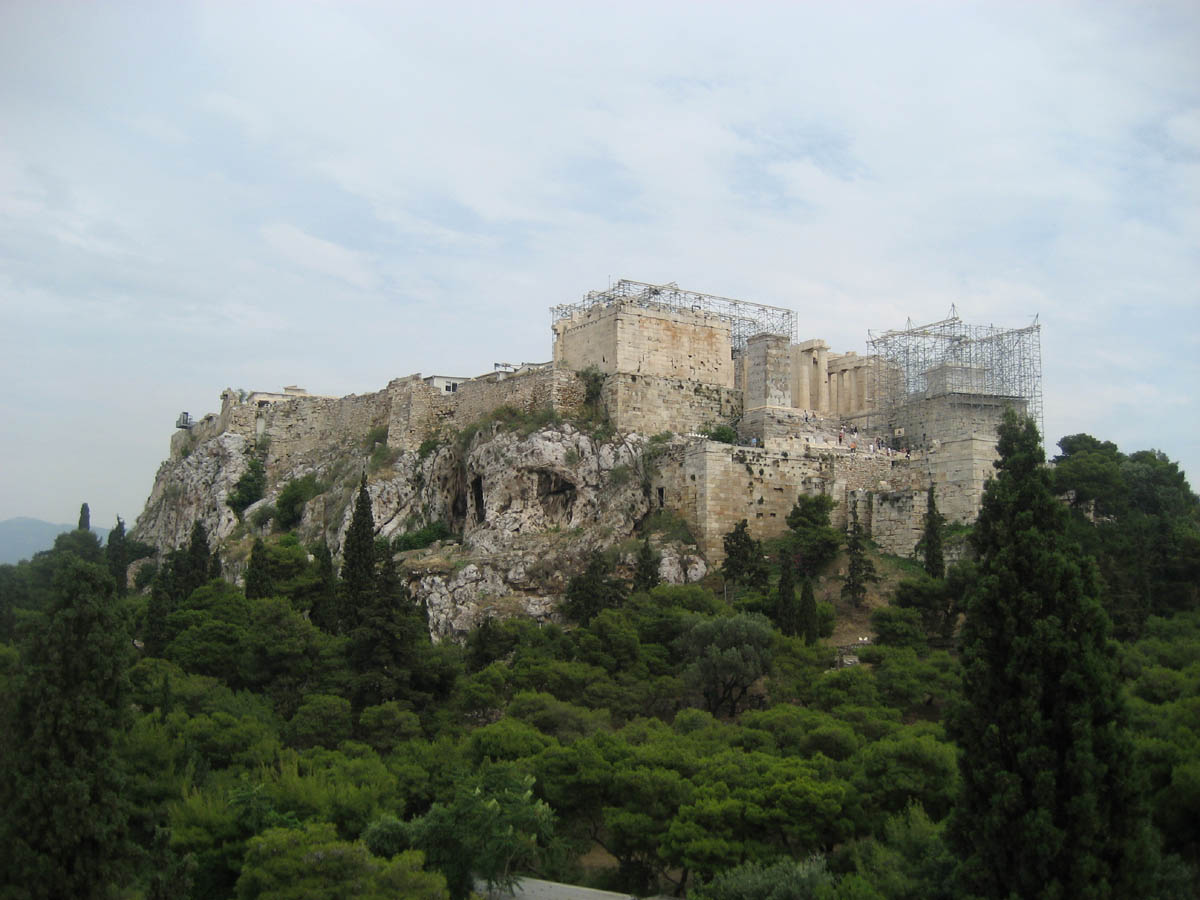
A view of the Acropolis from Mars Hill
Some of the local philosophers got into discussions with him and invited him to speak at Mars Hill, a little outcropping of marble rock just NW of the nearby acropolis and famous Parthenon. One might expect that a Jewish Christian, provoked as he was (Acts 16:16) about the idols would “lay into them” about their benighted ways. Instead, Paul deals gently, yet truthfully, with them. He calls them religious, a compliment — probably as he gestured toward the Parthenon close by. He leads them to arrive at the conclusion that God is not many but one, not living in humanly constructed temples needing to be served by men, and that he made us all. He, in fact, made a lot of headway, until he mentioned the resurrection, a real sticking point with the Greeks. Even so, some did come to be believe.
I’d like to note here, however, that being religious was simply not enough. Being moral (the philosophers spent their lives trying to discover truth, morality, and happiness) was not enough. Being smart and well-educated was not enough. Only Jesus is enough. I mention this, because we live in a world that thinks that these other things are enough. We must not get sucked into believing the lie that all is well with most of the “nice” world. Nice doesn’t cut it; John 14:6 “Jesus *said to him, “I am the way, and the truth, and the life; no one comes to the Father but through Me.”
The Priscilla and Aquila team — Acts 18:1-4
Paul wasn’t forced to leave the city of Athens, but chose to go to Corinth, where he spread the Gospel with great success for about the longest time he ever stayed anywhere. While he was there, he met a certain Aquila and Priscilla, who had been among the Jews who had been kicked out of the city of Rome for riots and disruptive disputes over a certain “Chrestus” (see Seutonius— probably a misunderstanding or mispronunciation of Christ in the disputes doubtlessly that occurred in the synagogues of the city.

Corinthian Temple
It is uncertain whether Paul converted them or they were converted in Rome or even on Pentecost. But one way or the other, they were a power husband and wife team that did a great deal of work in the early church. Of the two, it would seem that Priscilla may have actually been the more vocal of the two, since here name is listed first in a couple of occasions in the New Testament. This is great testimony of the power of an active Christian couple who work together in the cause of Christ. Perhaps your marriage could be just such a powerful team in your congregation!
See you tomorrow, Lord willing.
 parklinscomb
May the tribe of Eutychus increase! — Acts 19-21
Which baptism? — Acts 19:1ff
There are a number of baptisms mentioned in the Bible.
I mention these to note that baptisms have meanings, it’s not just about getting wet. When the 12 disciples that Paul discovered spoke of their baptism from John the Baptist, Paul commanded them to be baptized again, because they believed and had repented, into Christ for forgiveness of sins (Acts 2:38). This is Christian baptism and apparently it really does make a difference for what reason you are baptized. How were you baptized?
Seven Sons of Sceva — Acts 19:14ff
I find this story such a scream! Here are a bunch of charlatan exorcists trying leverage Jesus’ name as just one more magical incantation (Ephesus was big into magic, as the rest of the passage tells us). But rather than exorcising the demon, the evil spirit says, “I recognize Jesus, and I know about Paul, but who are you?” And the demoniac leaps on them and and beats them up, so that they fled out of that house naked and wounded! There are a couple lessons here: 1) don’t mess with evil spirits (Jude 8), because you don’t know what you’re getting into and 2) Jesus’ name is not one to use lightly or as some sort of magical incantation (like I’ve heard some televangelists use it). Jesus is after all the King of kings and Lord of lords.
A resurrection on Sunday — Acts 20:7ff
OK, this story could be poorly used as a warning against falling asleep in church, but I’ll not go there. I think it is on the other hand a great lesson about dedication to coming to the assembly. Poor Eutychus gets a raw deal lots of times, because he did fall asleep, but lets look at all the facts. The church was meeting on what we’d call Saturday evening, because they were using Jewish time, in which a day started 6PM. The early church, being peopled by a number of slaves, would meet in the evening after work was done. Eutychus, we might imagine, had been working all day long. The church was meeting in an upper room, which was doubtlessly warm. Oil lamps were the light in this early worship assembly, which were using up some of the oxygen in the room. Combine weariness, a naturally warm upper room, plenty of body warmth from a crowded room, a late hour, and oxygen eating lamps and you get plenty sleepy. To his credit, Eutychus probably sought out the window to get some fresh air and stay awake to hear what Paul was saying and participate in worship, but his weariness apparently got the better of him and fell asleep and out the window. Fortunately Eutychus was able to be raised from the dead, to everyone’s great relief; but consider the dedication that Eutychus had to just be there. It would have been easy and even understandable for Eutychus to excuse himself from the assembly, or go home early. But he not only came, but did his best to stay awake. Are you a Eutychus or a drop out (no pun intended), when you’re a little tired from a day’s work? Do you strive to hear God’s word and learn, or do you figure that you don’t really need what’s being taught or preached? I’d rather be a Eutychus than an absentee.
Shepherd the flock of God — Acts 20:17ff
This ought to be a regular study for any eldership. Paul masterfully outlines the responsibilities and critical nature of the ministry of the eldership (also known as shepherds and overseers, see the whole context). Too often elderships become more like a governing board, which may betray less noble reasons for aspiring to the office of an elder — getting to make the calls for the church. While authority to direct the affairs of the church is undoubtedly in the hands of the overseers of the congregation, knowing the flock, teaching the flock, healing the flock, feeding the flock, and defending the flock are priority responsibilities.
Arrest at the Temple — Acts 21:27ff
Paul’s arrest in the Temple was just one more time that this dedicated servant of God was arrested or otherwise persecuted in his lifetime. This arrest ultimately put him in continual custody for over four years — from Jerusalem to Caesarea to shipwreck to Rome. This tribulation had been prophesied for him, but instead of kicking dirt and complaining that it wasn’t fair or questioning God’s desire to save mankind (because, after all, Paul was doing so much successful missionary work), Paul clearly figured that God had some greater plan in mind for him — which indeed He did. May we have the same spiritual vision to see our own troubles in this way.
See you tomorrow, Lord willing.